Europe · Profile System
Salamander
🇩🇪 Germany · Last reviewed by Justin Orloff
Quick Facts
founded
1953
hq
Türkheim, Bavaria, Germany
primaryMaterials
PVC multi-chamber profiles
glazingPartner
Glazing by fabricator specification
marketTier
Mid-Range
Brand at a Glance
- Country: Germany
- Market position: Mid-range German PVC window profile manufacturer
- Primary materials: PVC multi-chamber profiles
- Product types: Residential window profiles, door profiles, sliding system profiles
- Colour options: White, cream, woodgrain foil, colour foil, co-extruded colour on some lines
- Standards: RAL quality mark, CE marked, German profile quality standards
- Distribution: Germany and European markets through fabricators
- End use: Residential windows and doors
- Sustainability: PVC recyclability programme participant
- Website: salamander.de
Product Range
- Residential tilt-and-turn window profiles
- Entrance door profiles
- Sliding and terrace door profiles
- Flush-sash profiles
Why This System
Salamander is a Bavarian manufacturer - their profiles appear heavily in south German and Austrian residential window stock, where mountain and alpine conditions create specific cleaning requirements. German RAL quality mark certification on Salamander profiles means consistent UV stability and dimensional accuracy across the product range - a reliable baseline for maintenance planning. Flush-sash Salamander profiles have no rebate step on the outer face - the sash sits flush with the frame, which changes water management during cleaning and requires attention to the drainage path. South German and alpine installations encounter more biological growth on north-facing window frames than urban German installations due to the higher humidity from proximity to forest and mountain environments. Salamander profiles are steel-reinforced in the main frame and sash sections - the steel reinforcement inside the PVC is not visible but means that any internal corrosion from water entry at cut ends affects the structural dimension of the frame.
Step 1 of 2: Manufacturer Recommendations
Official Care Guidance
Source: ORLOFFS PROFESSIONAL GUIDANCE - BASED ON SALAMANDER PUBLISHED INFORMATION AND 25 YEARS FIELD EXPERIENCE
Glass
- pH-neutral glass cleaner in warm water. Microfibre T-bar and professional squeegee.
- In forested locations, pre-treat any resin deposits on glass with resin remover before the main clean. Apply to glass only, rinse immediately after contact.
- On flush-sash profiles, control squeegee strokes to avoid running solution across the outer frame face.
- Edge wipe in rebate before final pull.
Frames
- pH-neutral solvent-free PVC cleaner on soft cloth for all Salamander frame types.
- On north-facing frames in forest locations: anti-algae treatment before standard cleaning on any green or black biological growth.
- On foil laminate colour profiles: no solvent products. Extra care at seam edges.
- Clear all sash drainage slots. On flush-sash profiles, confirm water can exit the sash base without obstruction.
Hardware
- Annual lubrication at all mechanism points: hinge scissors, corner transfer pieces, espagnolette rod guides.
- In alpine and pre-alpine locations, increase lubrication to twice yearly - higher humidity and temperature variation accelerates lubricant degradation.
- Check corner weld condition at annual service. Any cracking or opening at a corner weld needs professional repair to protect the steel reinforcement.
Step 2 of 2: The Orloffs Protocol
The Orloffs Protocol
This is how I clean Salamander windows. The tools and technique below come from 25 years of daily professional work on the glass. Every step has been tested on real installations and adapted specifically for Salamander systems.
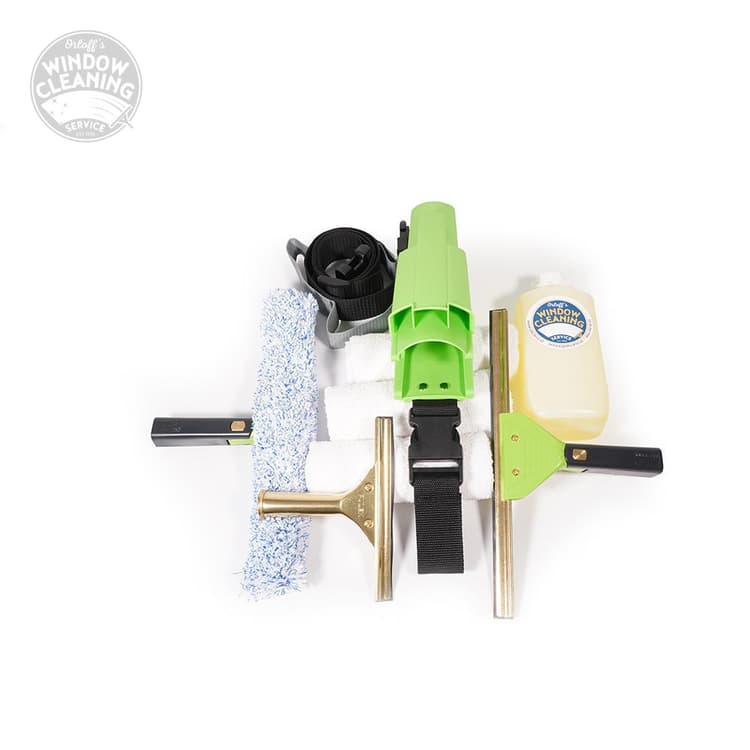
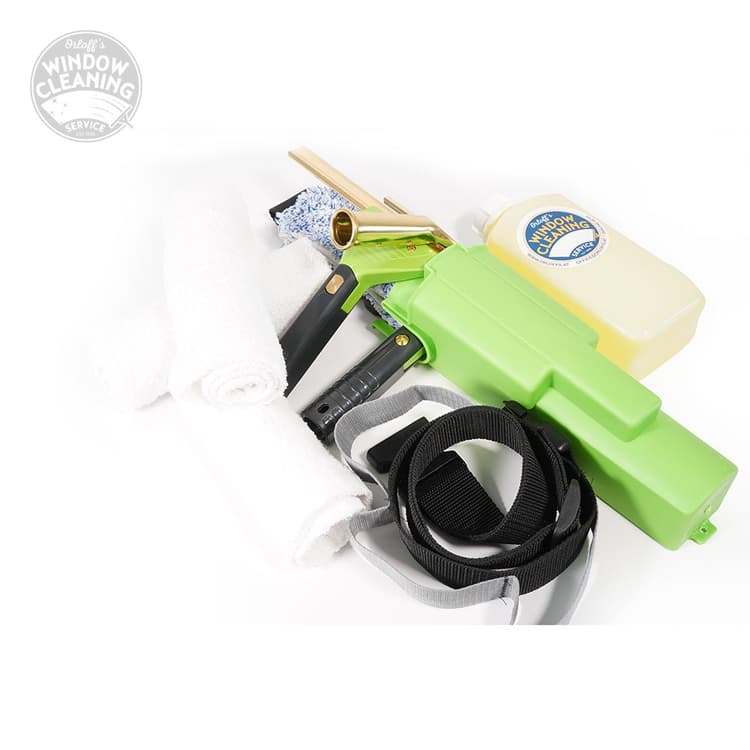
Pro Tools
My daily tool list. This is what I carry to every job.
Follow these steps in order. Each one builds on the last. This is the same sequence I use on every Salamander installation.
- 1
Location and environment assessment
Identify whether the installation is urban, suburban, or alpine/forested. Each presents different deposit types.
On forested locations, check all north-facing frames for biological growth before starting the main clean.
Check for resin deposits on glass in conifer-adjacent locations.
- 2
Pre-treatment for biological growth and resin
Apply anti-algae treatment to affected frame sections. Allow dwell time. Rinse before starting standard cleaning.
Apply resin remover to glass resin deposits. Brief contact, immediate rinse. Do not allow resin remover to contact PVC frame.
Allow pre-treatment surfaces to dry before applying standard cleaning products.
- 3
Glass cleaning
Apply solution with T-bar. On flush-sash, control strokes to minimise frame contact.
Squeegee top to bottom. Rubber wipe after each pass.
Edge wipe in rebate before final pull.
- 4
Frame cleaning
Apply pH-neutral solvent-free cleaner to cloth. Straight strokes.
Extra care on foil laminate near seam edges.
Clear all sash drainage slots.
- 5
Corner weld inspection
On older Salamander windows (10 years and above), check all four frame corner welds on each window for any gap opening or discolouration.
Report any corner weld failure to the property owner. Water entry at a corner weld reaches the steel reinforcement and causes structural swelling.
Do not attempt to repair corner welds with consumer sealants - professional PVC welding repair is required.
- 6
Hardware lubrication
Lubricate all mechanism points. Twice yearly in alpine locations.
Operate full tilt-and-turn cycle to distribute lubrication.
Check all locking points engage cleanly.
Pro Tips
- In south German and Austrian alpine locations, the first spring clean after winter snow and leaf debris season is the most demanding of the year. Budget more time per window for this visit than for subsequent cleans.
- Conifer resin on glass is the most commonly overlooked deposit type in forest-adjacent German residential windows. Standard glass cleaner just pushes it around. Identify it early - resin that has been partially cleaned and redistributed is harder to remove than fresh resin.
- Anti-algae treatment on north-facing Salamander frames works best applied in dry weather and allowed to dwell without rain interference. Plan the biological growth treatment visit separately from the main glass clean if possible.
- Flush-sash Salamander profiles are visually attractive but create a squeegee technique challenge. Practice keeping the squeegee rubber precisely on the glass face without touching the flush frame. A squeegee with a shorter rubber gives better control on flush-sash profiles.
- Steel reinforcement in Salamander profiles becomes a real concern when corner welds fail on older windows. The first sign is a brown stain leaking from the corner weld - iron oxide from the reinforcement. This window needs professional attention before the next cleaning visit.
- German forest locations with spruce or pine canopy over windows also have significant pollen load in spring. The spring clean after pollen season needs a longer T-bar dwell time to dissolve the waxy pollen film rather than dragging it across the glass.
- Salamander flush-sash windows on south German buildings are often contemporary design projects with larger glass areas per window than standard residential profiles. Larger glass areas reward a longer squeegee channel - 45cm rather than 35cm for faster coverage.
What NOT To Do
- Do not use resin remover on PVC frame surfaces - it attacks the PVC material.
- Do not skip anti-algae pre-treatment on north-facing frames in forest locations - standard cleaner on biological growth just spreads it.
- Do not ignore corner weld condition on older Salamander windows - steel reinforcement corrosion from failed welds is a structural issue.
- Do not clean flush-sash profiles with the same squeegee technique as stepped-rebate profiles - the frame contact pattern is different.
- Do not use solvents on foil laminate Salamander colour profiles.
Bundle Kits and Tool Recommendations
Bundle Kit
Tool Recommendations
pH-neutral solvent-free PVC cleaner
View on Amazon [coming soon]Anti-algae frame pre-treatment spray
View on Amazon [coming soon]Resin spot remover for glass surfaces
View on Amazon [coming soon]Cleaning Frequency
Glass: 2 to 3x per year (Alpine and forested locations: 3x minimum. Urban Germany: twice yearly standard.). Frames: Same visit as glass (Anti-algae pre-treatment on north-facing forest-location frames: check at every visit.). Drainage slots: Every clean (Standard PVC maintenance.). Hardware lubrication: Twice per year in alpine locations, once per year elsewhere (Higher humidity and temperature variation in alpine environments degrades lubrication faster.)
Frequently Asked Questions
Field Notes
“South German and Austrian window cleaning technicians encounter Salamander profiles regularly. The brand is particularly well represented in Bavarian residential stock from the 1990s and 2000s. The resin deposit and biological growth combination on north-facing windows in Bavarian forest locations is the most technically demanding standard residential window cleaning scenario in the German market. Flush-sash Salamander profiles on contemporary German residential projects are the cleanest-looking windows on the elevation when well maintained. They are also the most visible when the cleaning technique leaves marks on the flat outer face.”
Justin Orloff
What's next for you?
The Skill
New to window cleaning?
Start with the core techniques before tackling premium systems.
Start Learning →The Standard
Upskill your team
Covers every system, product type, and tricky scenario.
View The Standard →Manufacturer
Partner with Orloffs
Are you Salamander or a similar manufacturer? Let's create official cleaning guidance together.
Get in Touch →