
Europe · Hardware Manufacturer
Roto Frank
🇩🇪 Germany · Last reviewed by Justin Orloff
Quick Facts
founded
1935
hq
Leinfelden-Echterdingen (near Stuttgart), Germany
primaryMaterials
Window and door hardware/fittings (compatible with timber, uPVC, aluminium, timber/aluminium)
glazingPartner
N/A - hardware manufacturer, not a glass or window maker
marketTier
Premium
Brand at a Glance
- Founded: 1935
- HQ: Leinfelden-Echterdingen (near Stuttgart), Germany
- Market position: Global market leader for tilt/turn window hardware - 18 production plants, 40+ subsidiaries worldwide
- Product type: Window and door hardware/fittings (not a window manufacturer)
- Key ranges: Roto NX (tilt/turn), Roto AL (aluminium tilt/turn), Patio Inowa (sliding), Patio Lift (lift/slide), Patio Alversa (tilt/slide), Designo (roof windows)
- Compatible materials: Timber, uPVC, aluminium, timber/aluminium frames
- Warranty: 10-year warranty on hardware against material defects (conditions apply)
- Where they sell: Global - 40+ countries
- Official care page: media.ftt.roto-frank.com - installation manuals, maintenance videos
- Find a specialist partner: ftt.roto-frank.com/int-en/services/roto-spare-parts-service/
Product Range
- Roto NX
- Roto AL
- Patio Inowa
- Patio Lift
- Designo
Why This System
Roto is a hardware manufacturer, not a window maker - their products sit inside windows made by hundreds of different brands. Tilt/turn systems have multiple locking cams, strikers, scissor stays, and corner drives that all need lubrication. Steel security strikers need continuous greasing, not just annual lubrication. Sliding systems handle sash weights up to 400 kg - neglected running gear causes expensive failures. On Designo roof windows, hardware condition controls whether you can rotate the sash into cleaning position.
Step 1 of 2: Manufacturer Recommendations
Official Care Guidance
Source: ROTO FRANK OFFICIAL INSTALLATION, MAINTENANCE, AND OPERATION DOCUMENTATION
Hardware Cleaning
- Clean all hardware components with a soft cloth and mild, pH-neutral cleaning agent in diluted form only.
- Never use aggressive, acid-containing cleaners on hardware.
- Never use abrasive cleaning agents on hardware surfaces.
- Wipe hardware dry after cleaning. Do not leave moisture on metal components.
Lubrication - Tilt/Turn Systems (Roto NX, Roto NT)
- Grease or oil all operation-relevant components at least once per year with acid-free, resin-free lubricants.
- Use grease spray for general lubrication of moving parts.
- Lubricate all eccentric locking cams and strikers with clean, non-resinous oil.
- Steel security strikers need continuous greasing - not just annual treatment.
- Lubricate scissor stays and scissor-slider springs.
Lubrication - Sliding Systems (Patio Inowa, Patio Lift, Patio Alversa)
- Lubricate slider and scissor-slider springs.
- Grease the top guide track.
- Lubricate the pin guiding slot on the leading bogie and the guide block point of entry.
- Lubricate all strikers and locking cams.
Roof Windows (Designo Series)
- Use the cleaning position for exterior glass access. The sash rotates and locks automatically in cleaning position.
- All functions are operated using a single handle on the underside of the window.
- Lubricate the pivot mechanism annually to maintain smooth rotation into cleaning position.
Screws and Fixings
- Check all screws regularly. Tighten any that have loosened.
- Do not over-tighten. Stripped screw holes require professional repair.
Step 2 of 2: The Orloffs Protocol
The Orloffs Protocol
This is how I clean Roto Frank windows. The tools and technique below come from 25 years of daily professional work on the glass. Every step has been tested on real installations and adapted specifically for Roto Frank systems.
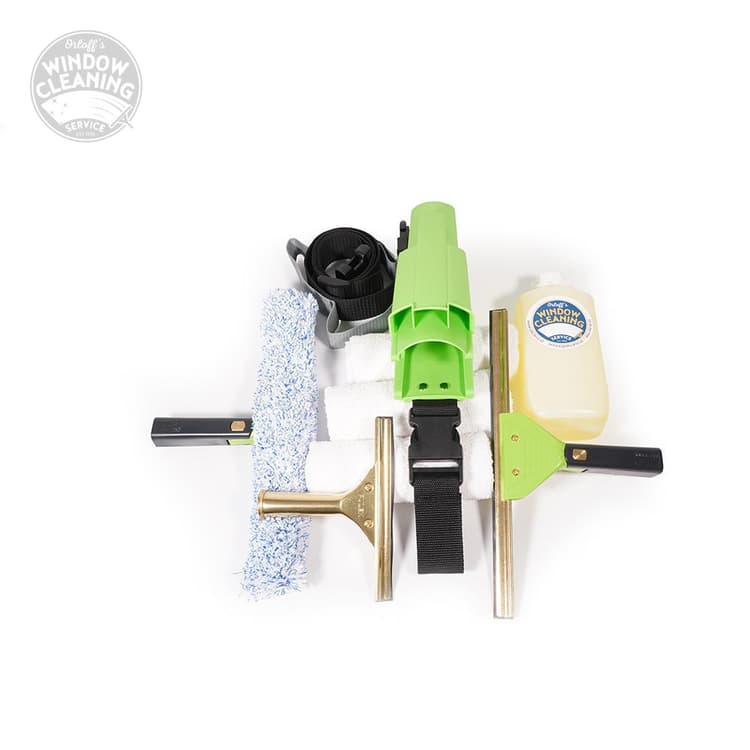
Pro Tools
My daily tool list. This is what I carry to every job.
Follow these steps in order. Each one builds on the last. This is the same sequence I use on every Roto Frank installation.
- 1
Hardware check before cleaning
Before touching the glass, operate the window. Open it fully, tilt it, close it. On tilt/turn windows with Roto NX or NT hardware, feel for stiffness in the handle rotation. If the handle is hard to turn, the locking cams need lubrication before you do anything else.
On sliding doors, slide the panel fully open and closed. Listen for grinding. Check the guide track for grit and debris.
- 2
Detail the frame edges first
Wipe down the window frame edges with a damp microfibre cloth and soap water. Clear the closing area where the sash meets the frame - this is where the Roto locking cams engage. Dirt in the closing area prevents proper seal compression.
This removes the dust and grit sitting on the frame before you agitate the glass. If you skip this, the squeegee picks up that dirt and drags it across the clean glass.
- 3
Agitation
Dip your T-bar applicator into the soap water on both sides. Apply the solution across the whole glass area using overlapping strokes. The goal is to dissolve the dirt so the squeegee can shave it away cleanly.
If dirt is not fully dissolved and released from the glass, it gets transported under the squeegee rubber and leaves smears. Take your time with the agitation step. Never clean glass in direct sunlight.
- 4
Detail frame edges before squeegeeing
Once the glass is agitated, run a dry corner of your cotton rag along the top edge and both side edges. This removes pooled soap water from the frame edge before the squeegee pass.
- 5
The three squeegee turns
Side to side: start at the top edge with a dry rubber. Work across the glass in straight horizontal lines. Tilt the squeegee so soap water spills from only one side. Wipe the rubber dry after each pass.
Top to bottom: same principle, working in vertical lines. Start in the top corner with a dry rubber. Tilt to direct water downward. Wipe dry after each pass.
The J tune (continuous motion): the professional continuous motion from top to bottom in one smooth, unbroken movement. Your thumb guides the rotation at the end of each horizontal pass. When this is in your muscle memory, it is the fastest turn for any window.
- 6
Final edge detailing
After squeegeeing, there is always a thin line of water along the bottom edge and at the sides. Take a dry cotton rag, fold it to a clean corner, and detail these edges in one smooth pass.
Get your finger into the edge where the glass meets the frame seal. Remove any pooled soap water. Rotate the rag so you are always using a clean, dry section.
Pro Tips
- Operate the window before cleaning - stiffness in the handle means the locking cams need lubrication first.
- Clean the closing area where the sash meets the frame - dirt there prevents proper seal compression.
- Steel security strikers need continuous greasing, not just annual treatment.
- On Designo roof windows, lubricate the pivot mechanism annually or you lose cleaning position access.
- Do not use WD-40 - it evaporates and leaves hardware dry within weeks. Use acid-free, resin-free lubricants.
What NOT To Do
- No aggressive or acid-containing cleaners on hardware - they attack the corrosion protection.
- No abrasive cleaning agents on hardware surfaces.
- No resinous oils or greases - they gum up locking mechanisms over time.
- Do not skip annual lubrication - wear and tear accelerates without it.
- Do not force a stiff handle - if the tilt/turn mechanism resists, lubricate before applying more force. Forcing damages the gearbox.
- Do not ignore loose screws - a loose striker or hinge fixing changes the seal compression on the entire window.
- No pressure washer on windows - high-pressure water forces past seals and into the hardware cavity, causing corrosion.
- Do not let grit accumulate in sliding door guide tracks - abrasive particles grind into the running gear and damage the bogie wheels.
Bundle Kits and Tool Recommendations
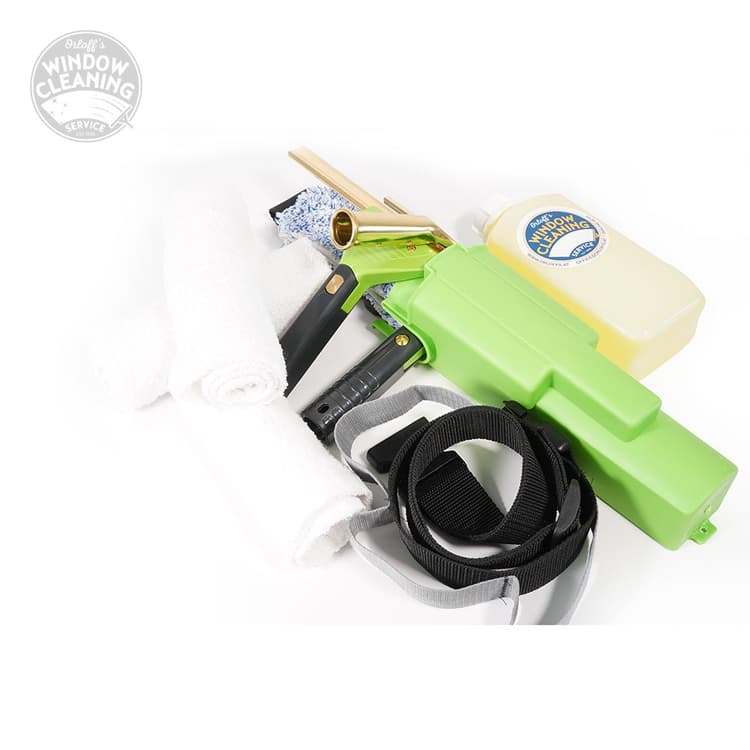
Bundle Kit
Tool Recommendations
T-bar applicator with microfibre cover
View on Amazon [coming soon]Professional squeegee with fresh rubber blade
View on Amazon [coming soon]Bucket with lukewarm water + 1 drop of mild pH-neutral dish soap per litre
View on Amazon [coming soon]Cleaning Frequency
Glass and frames: 2x per year minimum (Near industrial areas, railways, or busy roads: increase to quarterly.). Hardware lubrication: 1x per year minimum (Acid-free, resin-free grease for locking cams, oil for strikers.). Steel security strikers: Continuous greasing (Check at every cleaning visit - these need heavier treatment than standard strikers.). Sliding door guide tracks: Every cleaning visit (Clear debris at every visit, full lubrication annually.). Screw check: 1x per year (Check all visible hardware fixings. A loose striker changes seal compression on the entire window.). Roof window pivot: 1x per year (Lubricate before you lose cleaning position access.)
Frequently Asked Questions
Field Notes
“Glass and frames: 2x per year minimum, quarterly near industrial areas or busy roads. Hardware lubrication: annual with acid-free, resin-free grease and oil - do not use WD-40. Steel security strikers: continuous greasing, checked at every cleaning visit. Sliding door guide tracks: clear debris every visit, full lubrication annually. Roof window pivot mechanism: annual lubrication or you lose cleaning position access.”
Justin Orloff
What's next for you?
The Skill
New to window cleaning?
Start with the core techniques before tackling premium systems.
Start Learning →The Standard
Upskill your team
Covers every system, product type, and tricky scenario.
View The Standard →Manufacturer
Partner with Orloffs
Are you Roto Frank or a similar manufacturer? Let's create official cleaning guidance together.
Get in Touch →