
Europe · Window Manufacturer
Eko-Okna
🇵🇱 Poland · Last reviewed by Justin Orloff
Quick Facts
founded
1992
hq
Wodzislaw Slaski, Silesia, Poland
primaryMaterials
PVC-U (primary), aluminium, timber
glazingPartner
European glass suppliers - glazing specified per series and market
marketTier
Volume / Mid-Range
Brand at a Glance
- Founded: 1992
- HQ: Wodzislaw Slaski, Silesia, Poland
- Market position: Volume and mid-range PVC, aluminium, and timber windows - one of Europe's largest producers
- Primary material: PVC-U (majority production), aluminium systems, solid timber
- Profile systems: Multiple European profile systems including Veka - varies by product line
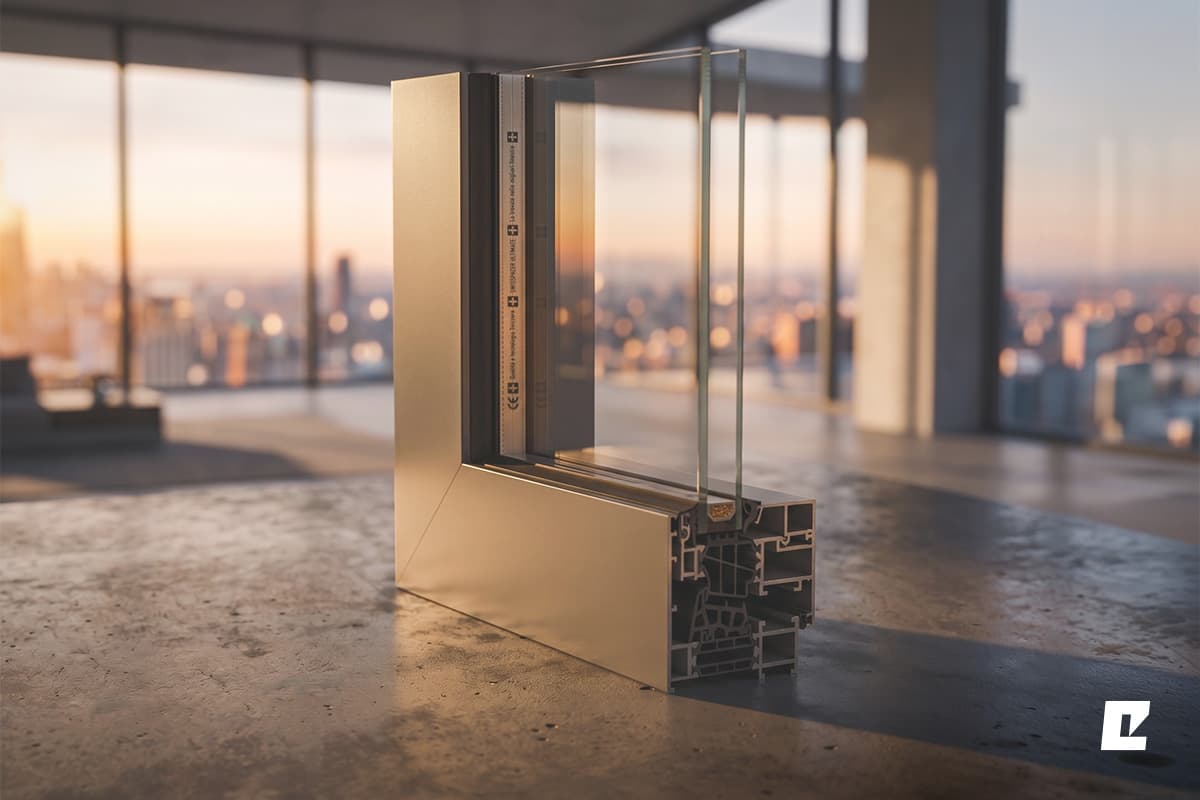
- Chamber count: 5 to 7 chambers depending on specification
- Colour options: White standard, laminate foil in woodgrain and solid colours, metallic finishes
- Distribution: Poland, Germany, UK, Czech Republic, and wider EU market
- Certification: CE certification, RAL quality mark on selected lines
- Website: eko-okna.eu
Product Range
- PVC Windows (volume residential)
- Aluminium Windows and Doors
- Timber Windows
- Sliding Systems
Why This System
Eko-Okna's volume production scale means their quality control processes are industrial-grade - product consistency across millions of units is a genuine strength, not a marketing claim. Their PVC product uses profiles from multiple European system suppliers depending on the product line and destination market - this means the profile geometry and drainage slot position can vary between different Eko-Okna products. Colour laminate foil on Eko-Okna PVC windows uses a laminated (rather than co-extruded) surface film on several product lines - laminated foil and co-extruded foil respond similarly to cleaners, but the edge detail at the foil join differs. Eko-Okna products are typically specified in the value segment of each market they serve - the buyer expectation is long-term performance at a reasonable price, not premium finish quality. The cleaning requirement is the same as for premium PVC but the tolerance for minor surface imperfection is slightly higher. UK-market Eko-Okna products sometimes carry different hardware specifications from Polish-market equivalents - Maco, Winkhaus, or Siegenia hardware depending on the UK fabricator or distributor who has finished the window.
Step 1 of 2: Manufacturer Recommendations
Official Care Guidance
Source: ORLOFFS PROFESSIONAL GUIDANCE - BASED ON EKO-OKNA PUBLISHED INFORMATION AND 25 YEARS FIELD EXPERIENCE
Glass
- Lukewarm water with mild soap or a dedicated glass cleaner. Volume production means consistent specifications - but confirm coatings on any specification you have not cleaned before.
- Microfibre T-bar on the wash, professional squeegee on the pull. Fresh rubber. At volume, rubber condition degrades faster - check and replace rubber more frequently on large-site cleans.
- No razor blades without confirming the glass specification. Eko-Okna products in the new-build market frequently include easy-clean or low-E coatings.
- After squeegeeing, wipe the frame perimeter - at volume, this step is the one most commonly skipped. Squeegee drips on white PVC frames dry as visible marks.
Frames
- Wipe with damp cloth and pH-neutral cleaner. On large sites, use a bucket system that keeps the cleaning solution clean - dirty solution redeposits grime on frames.
- No bleach, chlorine, or strong alkali. No solvent-based products. No abrasive pads.
- Clear drainage slots at every window. On a development with 200 windows, this takes time - but blocked drainage on any window causes water damage that is expensive to remedy.
- On colour laminate installations, handle the foil edges at corners carefully. Test any new cleaning product on one inconspicuous window before applying across the full development.
Hardware
- Wipe hardware with a damp cloth and dry immediately. Steel hardware on volume-tier PVC is durable but not corrosion-proof when left persistently wet.
- Check hardware function on every window - at volume, a stiff mechanism that needs lubrication is easy to miss. Operate each window through the full range.
- Lubricate all moving points annually. On a large development, annual hardware lubrication should be a separate scheduled service item, not an afterthought on the glass clean visit.
Step 2 of 2: The Orloffs Protocol
The Orloffs Protocol
This is how I clean Eko-Okna windows. The tools and technique below come from 25 years of daily professional work on the glass. Every step has been tested on real installations and adapted specifically for Eko-Okna systems.
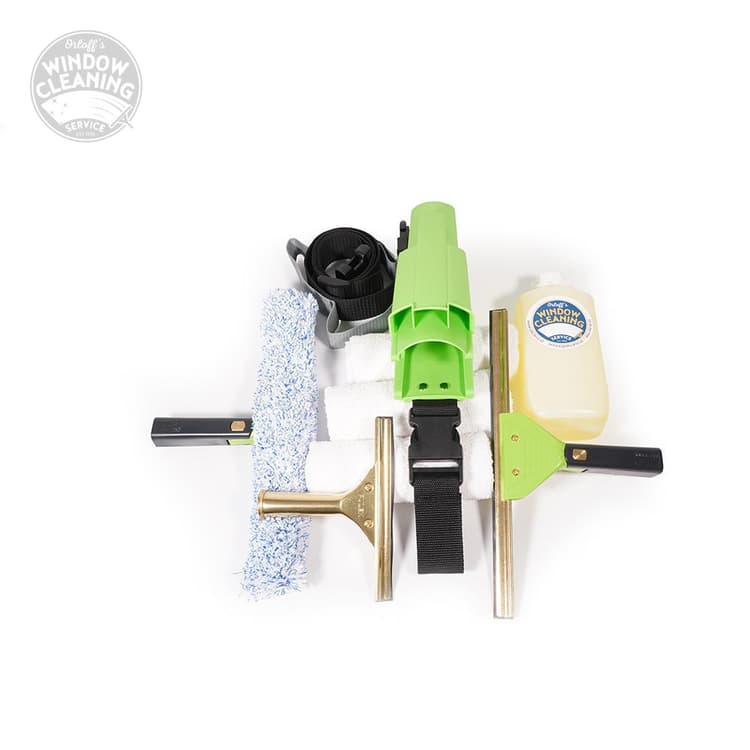
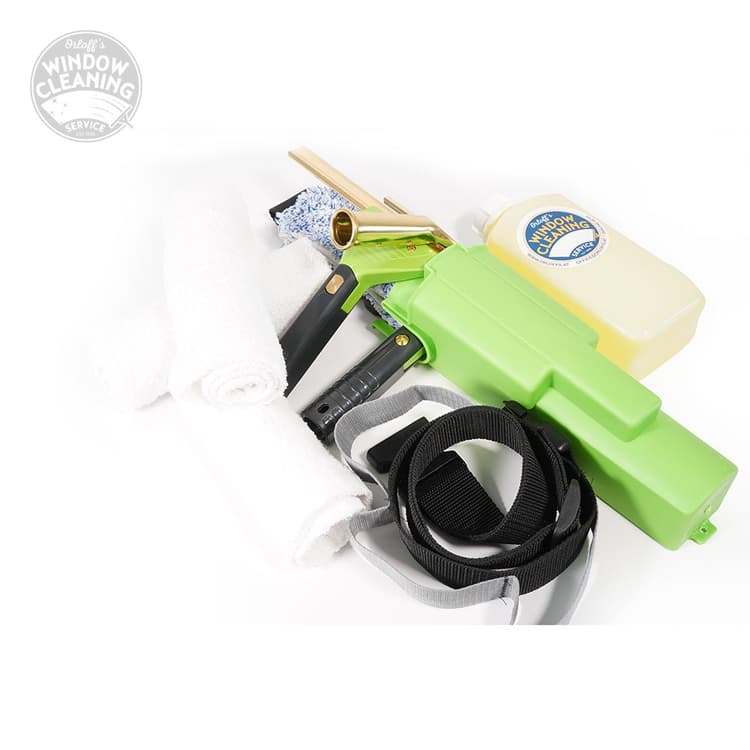
Pro Tools
My daily tool list. This is what I carry to every job.
Follow these steps in order. Each one builds on the last. This is the same sequence I use on every Eko-Okna installation.
- 1
Site setup and product check
On a first visit to an Eko-Okna development, walk one elevation and identify the profile series, colour specification, and glazing type before starting. Confirm the glass specification with the site manager or building manager if possible.
Identify the drainage slot position on the specific profile series present. On Eko-Okna products built on different profile systems, the slot is in a slightly different position - find it on the first window and it will be consistent across the development.
Set up your cleaning station with enough solution to cover the full site without needing to remix mid-clean. Consistent dilution matters at volume - too much soap creates foam and residue; too little leaves the solution ineffective.
- 2
Glass wash
Work in a consistent sequence across the development - top floor first, ground floor last, or left-to-right across each elevation. Consistent sequencing prevents skipped windows on large sites.
Apply solution with the T-bar in overlapping passes. Rotate T-bar covers more frequently than on a single-property job - a cover that has been used on 20 windows carries accumulated grime that scratches the glass on the 21st.
Allow dwell time on any windows with heavy soiling. New-build developments often have construction dust or paint splatter - dwell time is more effective than pressure on these soils.
- 3
Drainage check
Before squeegeeing each window, check the drainage slot condition. At volume, this is the step most likely to be skipped under time pressure - build it into the sequence so it happens automatically.
On Eko-Okna volume installations, drainage slots are frequently clogged with dust from the construction phase if the windows have not been cleaned since installation. Construction dust in drainage slots sets hard - it needs the wooden pick rather than a brush.
If a drainage slot is blocked solid and will not clear with a pick, flag the window number to the site manager. A blocked slot that has been wet repeatedly may have water behind the glass unit already.
- 4
Squeegee
At volume, a consistent squeegee technique is more important than a complex one. Side-to-side passes with a 45 cm channel covers standard residential Eko-Okna panel sizes efficiently.
Wipe the rubber after every pass. On large sites, rubber condition degrades through the day - check the rubber at every floor break and replace if it is leaving marks.
Bottom pass: direct the bead toward the drainage slot and away from the frame. At volume, squeegee bead left in the bottom frame rebate dries as a white mineral line across the full width of every window - visible from outside.
- 5
Frame wipe-down
Wipe all frame faces with pH-neutral cleaner on a damp cloth. On volume sites with identical windows, develop a consistent sequence for the frame wipe - top rail, left stile, right stile, bottom rail, sash perimeter. Consistent sequencing prevents missed sections.
Pay attention to the welded corners on every window. Grime accumulates in the PVC corner weld and is consistently missed at volume. A detail cloth at each corner adds 10 seconds per window and produces a significantly better result.
Rotate cloths frequently. A cloth that has wiped 10 frames carries enough accumulated grime to redeposit visibly on the next frame.
- 6
Hardware and completion
Operate each window through the full range. At volume this takes time - but a stiff or non-functioning mechanism on a new-build property is a warranty issue as well as a maintenance issue, and finding it during the clean is valuable.
Record any hardware issues by window number or position on the elevation. On a development with many windows, an unrecorded hardware issue is an unfindable hardware issue when the site manager follows up.
Do a final walk of each elevation after cleaning. From 10 metres away, any missed squeegee drips, frame marks, or skipped windows are visible. At volume, the walk saves remedial work.
Pro Tips
- On new-build Eko-Okna developments, construction dust in the drainage slots sets as hard as plaster - clean these with a wooden pick on the first visit, then they are manageable with a brush on subsequent visits.
- Colour laminate Eko-Okna windows in woodgrain finishes are common in the German and Austrian market. The foil edges at the corners are the vulnerability - check corners on every window of a colour install, not just the ones that look problematic.
- Volume PVC cleaning is a quality discipline as much as a technique - the challenge is maintaining standard on the 80th window as well as the first. Develop a sequence and stick to it.
- Eko-Okna hardware in UK-market products is sometimes from a UK fabricator specification rather than Polish standard - if the hardware operates differently from what you expect, identify it before lubricating with the wrong product.
- At volume, squeegee rubber condition is a bigger variable than on single-property cleans. Replace rubber at fixed intervals rather than waiting for visible performance degradation.
- If the development has both white PVC and colour laminate windows, clean the colour laminate windows first with a fresh solution - the foil surface shows solution contamination more clearly than white PVC.
- On large Eko-Okna new-build sites, the first professional clean after construction is significantly more intensive than subsequent cleans - price it accordingly and bring more T-bar covers and cloths than you think you need.
What NOT To Do
- No bleach, chlorine, or strong alkali on any Eko-Okna PVC surface - white or colour laminate.
- No solvent-based cleaners on frames or adjacent seals.
- No abrasive pads on any PVC frame surface.
- Do not skip drainage slot clearing at volume - blocked drainage on 10 windows in a development causes significant cumulative water damage.
- Do not use dirty cleaning solution on colour laminate windows - contaminated solution redeposits grime on the foil surface and is visible against dark or woodgrain finishes.
Bundle Kits and Tool Recommendations
Bundle Kit
Tool Recommendations
Unger ErgoTec Ninja squeegee, 45 cm
View on Amazon [coming soon]Microfibre T-bar applicator with multiple replacement covers
View on Amazon [coming soon]pH-neutral PVC frame cleaner, large volume
View on Amazon [coming soon]Cleaning Frequency
Glass: 2x per year minimum (Spring and autumn. Urban and roadside locations: quarterly. New-build first clean: as soon as construction dust allows.). Frames: 2x per year (Same visit as glass. New-build first clean requires more frame cleaning time than subsequent visits.). Drainage slots: Every clean (At volume, this is the step most at risk of being skipped. Build it into the sequence.). Hardware lubrication: Once per year (Separate scheduled visit on large developments - do not attempt hardware lubrication as part of a volume glass clean.)
Frequently Asked Questions
Field Notes
“Eko-Okna new-build developments in Poland and Germany are often the first professional glass clean these windows have received since installation - construction dust in the drainage slots and on the frame surfaces is more severe than on a maintained property. The profile variation across Eko-Okna product lines means the first visit to any new Eko-Okna site should include a 10-minute walk to identify the specific profiles present - this saves time and prevents mistakes during the clean. UK-market Eko-Okna products are sometimes sold under a different brand name by the importing distributor - the profile and quality are Eko-Okna's, but the brand label may differ. The cleaning approach is identical.”
Justin Orloff
What's next for you?
The Skill
New to window cleaning?
Start with the core techniques before tackling premium systems.
Start Learning →The Standard
Upskill your team
Covers every system, product type, and tricky scenario.
View The Standard →Manufacturer
Partner with Orloffs
Are you Eko-Okna or a similar manufacturer? Let's create official cleaning guidance together.
Get in Touch →