Europe · Profile System
Domal
🇮🇹 Italy · Last reviewed by Justin Orloff
Quick Facts
founded
Italian aluminium profile manufacturer, established presence in the European market
hq
Rho, Milan, Italy
primaryMaterials
Aluminium extrusion profiles - anodised and powder-coated
glazingPartner
System supplier - glazing specified by fabricator
marketTier
Premium
Brand at a Glance
- Country: Italy
- Base: Rho, Milan, Italy
- Market position: Premium aluminium profile systems for windows, doors, and facades
- Primary material: Aluminium extrusions - anodised (Class 10, 15, 20) and powder-coated
- Key ranges: 45 series, 52 series, 65 TT (thermally broken), curtain wall systems
- Thermal break: Polyamide thermal break on residential and premium commercial series
- Colour options: Anodised silver, bronze, champagne; extended RAL and NCS powder-coat range
- Distribution: Profile systems supplied to fabricators in Italy and internationally
- Application: Residential windows and doors, commercial curtain wall, shopfronts, industrial glazing
- Website: domal.it
Product Range
- Residential Thermally-Broken Series (65 TT)
- Commercial Aluminium Systems
- Curtain Wall and Facade Systems
- Sliding and Lift-and-Slide Systems
Why This System
Domal's Italian design heritage means the profile proportions and surface finish quality are held to a higher standard than pure-utility aluminium systems - the appearance of the clean result matters as much as the function. Anodised aluminium on Domal profiles is a surface conversion process that creates an aluminium oxide layer - it is part of the metal, not a coating on top of it. Acid-based cleaners dissolve the anodised layer permanently. Powder-coat on Domal profiles is applied over an anodised primer in many cases, giving a more durable substrate than powder-coat over bare aluminium - but the powder-coat surface is still sensitive to concentrated alkalis and abrasives. Thermally-broken Domal profiles have a polyamide insert between the inner and outer aluminium sections. This insert is not exposed during normal cleaning but can be reached if cleaning tools are pushed into the thermal break junction. Do not probe the thermal break. Domal curtain wall systems use structural silicon joints that are part of the building's weather envelope. These joints must not be disturbed, cut into, or cleaned with any product that affects silicon cure or adhesion.
Step 1 of 2: Manufacturer Recommendations
Official Care Guidance
Source: ORLOFFS PROFESSIONAL GUIDANCE - BASED ON DOMAL PUBLISHED INFORMATION AND 25 YEARS FIELD EXPERIENCE
Glass
- Lukewarm water with mild soap or a dedicated glass cleaner. No ammonia-based cleaners - safe on the glass but aggressive on adjacent anodised aluminium if contact is made.
- Microfibre T-bar on the wash, professional squeegee on the pull. Fresh rubber. Italian aluminium systems often have slim sightlines with less frame surface to catch squeegee drips - but squeegee control still matters.
- Confirm glass specification before using hard tools. Commercial Domal systems may have solar control or reflective coatings. No razor blades on coated glass.
- Direct the squeegee bead away from the frame face. Solution drying on anodised aluminium leaves mineral deposits that require specific treatment to remove.
Frames
- Wipe aluminium frame faces with a damp cloth and pH-neutral cleaner. Rinse thoroughly. Dry to prevent mineral deposits from hard water drying on the surface.
- No acid-based cleaners on anodised aluminium - permanent surface damage. No concentrated alkaline cleaners on powder-coat - etching and chalking.
- No abrasive pads, wire wool, or scouring products on any aluminium surface, anodised or powder-coated.
- On limescale deposits from hard water, use a dedicated aluminium-safe limescale remover. Test first on an inconspicuous area. Rinse thoroughly after use.
Hardware
- Wipe hardware with a damp cloth and dry immediately. Steel components in aluminium frames are prone to rust staining if left wet - the stain marks the adjacent aluminium frame face.
- Lubricate all moving hardware points - hinges, locking mechanisms, sliding tracks - with a purpose-made aluminium window hardware lubricant or light machine oil once per year.
- On sliding and lift-and-slide systems, clean the track channel at every visit. Grit in the track channel wears the threshold seal and the track surface under the running rollers.
Step 2 of 2: The Orloffs Protocol
The Orloffs Protocol
This is how I clean Domal windows. The tools and technique below come from 25 years of daily professional work on the glass. Every step has been tested on real installations and adapted specifically for Domal systems.
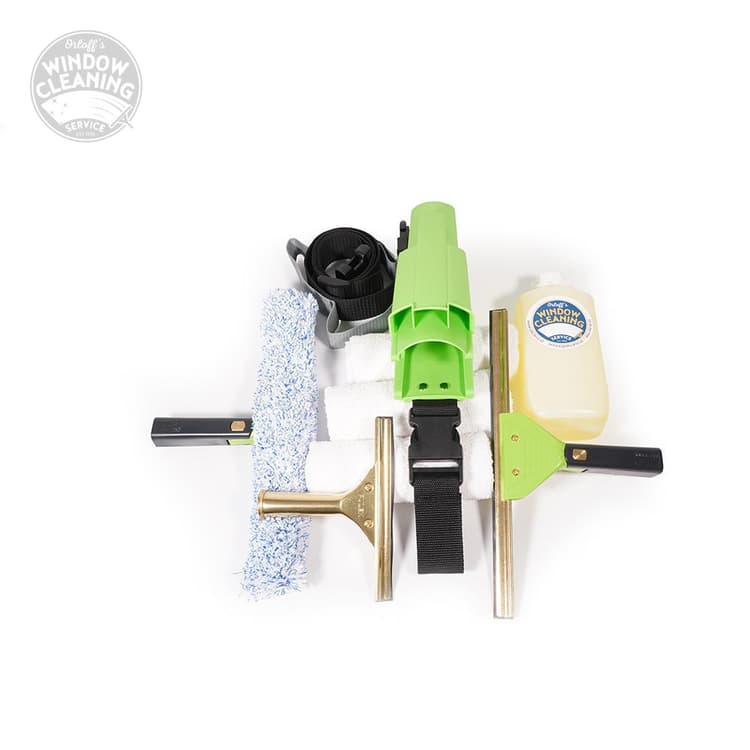
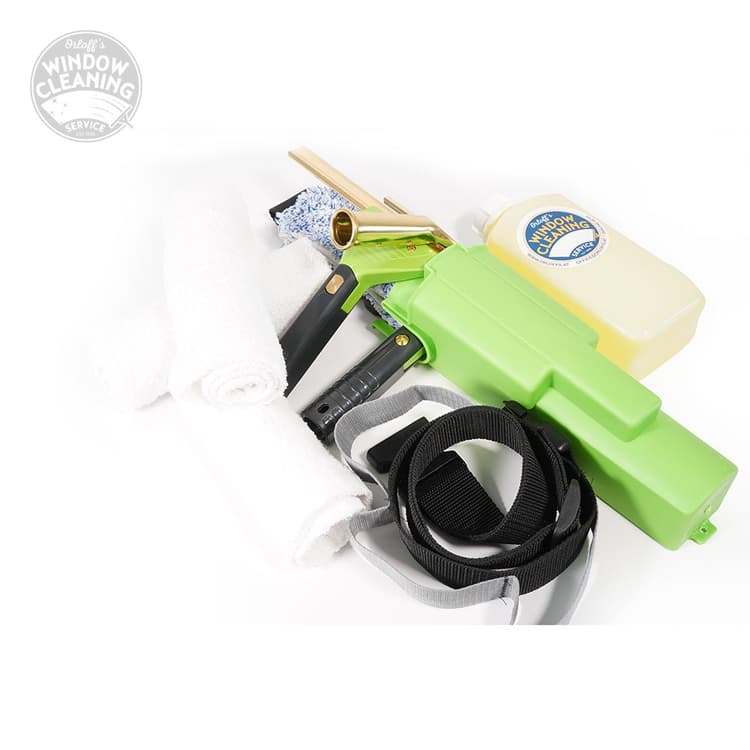
Pro Tools
My daily tool list. This is what I carry to every job.
Follow these steps in order. Each one builds on the last. This is the same sequence I use on every Domal installation.
- 1
Preparation
Identify the surface finish - anodised or powder-coated. Anodised aluminium has a metallic sheen in silver, bronze, or champagne. Powder-coat has a flat or satin finish in any RAL colour. The cleaning chemistry is similar, but limescale treatment differs slightly between the two.
Check the glass specification. On commercial Domal systems, reflective or solar control coatings are common. On residential systems, low-E coatings are standard. Note this before starting.
On curtain wall systems, identify the silicon joint lines before washing. These are the rubber or silicon beads between glass panels or between glass and aluminium. They must not be disturbed.
- 2
Glass wash
Apply soap solution with the T-bar in controlled strokes. On slim-profile Domal systems, the frame face is narrow - keep the T-bar on the glass and away from the anodised frame to avoid picking up aluminium oxidation particles on the T-bar cover.
On curtain wall installations, work panel by panel. The silicon joints between panels are vulnerable if a T-bar full of soapy water is dragged across them repeatedly.
Allow dwell time on heavy soiling. On urban commercial facades, Domal aluminium systems accumulate traffic pollution that needs agitation before the squeegee phase.
- 3
Edge detail
Before squeegeeing, wipe the rebate edge with a damp cloth. On aluminium systems, the rebate is typically shallower than on PVC - the edge detail takes less time but is still necessary.
On curtain wall silicon joints, dry the glass surface within 10 mm of the joint. Do not touch the silicon bead.
On sliding system glass, dry the top edge of the glass above the track - drips from the top glass edge during the squeegee pass fall into the track and accumulate there.
- 4
Squeegee
Cut in at the top, side-to-side passes. On Italian aluminium systems with slim profiles, the frame is narrow but the glass is correspondingly large - a fanning technique covers large panels efficiently.
Direct the squeegee bead down and toward the frame centre, away from the silicon joints on curtain wall systems.
Wipe the rubber dry after every pass. On anodised aluminium frames, solution from the rubber rubber leaves a visible watermark on the metallic surface if not removed.
- 5
Frame wipe-down
Wipe all aluminium frame faces with pH-neutral cleaner on a damp cloth. Work methodically around the perimeter. Pay attention to the sharp corners of extruded aluminium profiles - grime accumulates in internal corners.
Rinse with clean water on a separate cloth. Dry the frame surface immediately after rinsing - mineral deposits from hard water drying on anodised aluminium are more difficult to remove than solution residue.
On sliding track channels, use the soft-bristle brush to clear grit and debris after the frame wipe. The track channel is the single highest-wear point on any sliding aluminium system.
- 6
Hardware and final checks
Wipe all visible hardware with a damp cloth and dry immediately. On commercial Domal installations, hardware is often stainless steel and more corrosion-resistant than on residential systems, but drying is still good practice.
Operate windows and doors through the full range. Check handle operation, locking engagement, and on sliding systems, the smoothness of the slide. Resistance in a sliding system means either grit in the track or hardware needing lubrication.
On curtain wall systems, do a final check of all silicon joint lines after cleaning. Solution residue drying on a silicon joint is visible as a white film - remove with a barely damp cloth before leaving the site.
Pro Tips
- On anodised aluminium in bronze or champagne finishes, water marks are more visible than on standard silver - dry the frame surface immediately after rinsing, before water has a chance to dry on its own.
- Slim-profile Italian aluminium systems have less frame surface to manage but the proportional impact of a single water mark or abrasion scratch is higher - quality of finish matters more on a premium design-conscious product.
- If limescale has built up on Domal aluminium frames from hard water, remove it with a dedicated aluminium-safe product before the main clean - removing the limescale first gives a cleaner result from the frame wipe-down.
- On commercial Domal shopfronts and curtain wall systems, the track channel at the base of sliding panels collects cigarette ends, grit, and food debris in addition to normal airborne dust - budget time for a thorough track clean at each visit.
- Powder-coated Domal frames in dark colours (dark grey, anthracite, black) show fingerprints and smear marks from cleaning tools - always do a final dry buff with a clean cotton cloth on dark powder-coat frames.
- On thermal break Domal profiles (65 TT series), the polyamide thermal break is visible as a dark line running through the frame profile edge. Do not probe into this line with tools during cleaning.
- Annual application of a dedicated aluminium restorer on exposed Domal profiles maintains the surface appearance and protects against slow oxidation on anodised finishes - this takes 10 minutes per elevation and makes a significant difference over years.
What NOT To Do
- No acid-based cleaners on anodised aluminium - permanent and irreversible surface damage.
- No concentrated alkaline cleaners on powder-coat - etching and chalking that cannot be reversed in the field.
- No abrasive pads, wire wool, or scouring cloths on any aluminium frame surface.
- Do not apply cleaning products to silicon structural joints on curtain wall systems.
- Do not probe the thermal break junction on thermally-broken Domal profiles with cleaning tools.
Bundle Kits and Tool Recommendations
Bundle Kit
Tool Recommendations
Unger ErgoTec Ninja squeegee
View on Amazon [coming soon]Microfibre T-bar applicator
View on Amazon [coming soon]pH-neutral aluminium-safe frame cleaner
View on Amazon [coming soon]Cleaning Frequency
Glass: 2x per year minimum (Spring and autumn. Commercial and hospitality applications: quarterly or monthly depending on exposure.). Aluminium frames: 2x per year (Same visit as glass. Annual aluminium restorer on exposed elevations.). Track channels: Every clean (Sliding system track channels need clearing at every visit. Grit accumulation is the main cause of track and seal wear.). Hardware lubrication: Once per year (All moving points. Purpose-made aluminium hardware lubricant or light machine oil.)
Frequently Asked Questions
Field Notes
“Italian aluminium systems from manufacturers like Domal are designed with visual quality in mind - the anodised finish is considered part of the design, not just a protection layer. Clients notice surface marks on Italian aluminium more quickly than on utilitarian commercial aluminium. The track channel on Domal sliding systems is the highest-maintenance point on the whole installation - more time spent on the track at each clean saves more money in seal replacement and hardware adjustment than any other single maintenance action. Limescale on anodised bronze Domal frames is particularly visible against the warm metallic tone - identify hard water properties on site during the first visit and plan limescale removal into the cleaning protocol from the start.”
Justin Orloff
What's next for you?
The Skill
New to window cleaning?
Start with the core techniques before tackling premium systems.
Start Learning →The Standard
Upskill your team
Covers every system, product type, and tricky scenario.
View The Standard →Manufacturer
Partner with Orloffs
Are you Domal or a similar manufacturer? Let's create official cleaning guidance together.
Get in Touch →