Europe · Profile System
Aluplast
🇩🇪 Germany · Last reviewed by Justin Orloff
Quick Facts
founded
1982
hq
Karlsruhe, Germany
primaryMaterials
uPVC (unplasticised PVC)
glazingPartner
Varies by fabricator
marketTier
Mid-Range
Brand at a Glance
- Founded: 1982
- Headquarters: Karlsruhe, Germany
- Core product: uPVC profile systems
- Market presence: 90+ countries
- Profile depth range: 58mm to 85mm+ systems
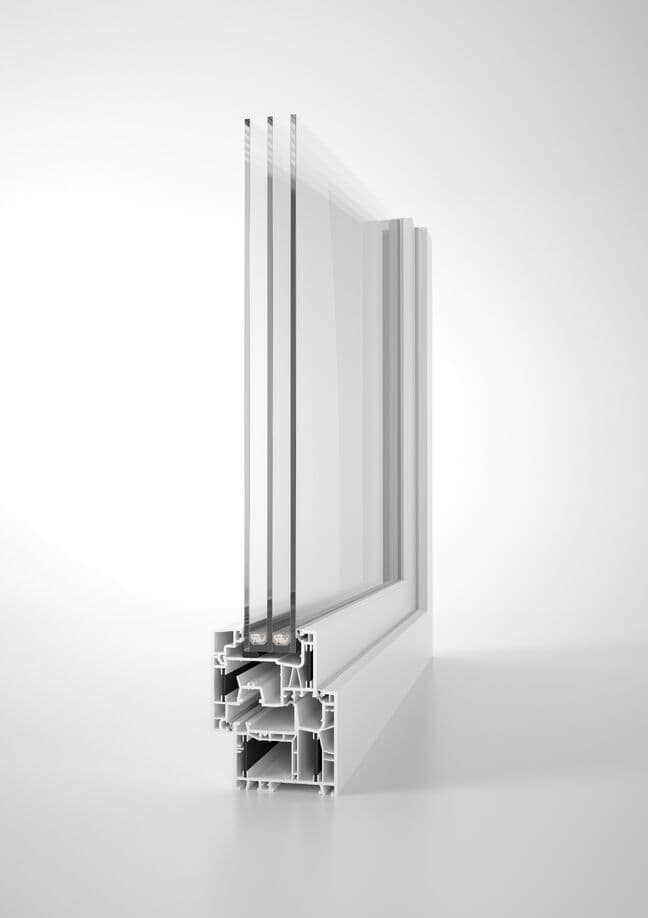
- Chamber design: Multi-chamber for thermal insulation
- Colour options: White, foil-laminated woodgrain, solid colours
- End product: Windows and doors built by licensed fabricators
- Market tier: Mid-Range
- Notable system: IDEAL 4000, IDEAL 7000, IDEAL 8000
Product Range
- IDEAL 4000
- IDEAL 7000
- IDEAL 8000
- Haustüren / Door Systems
Why This System
One of the first PVC profile makers to achieve widespread pan-European distribution - profiles appear in windows across Austria, Germany, Poland, Czech Republic and beyond. Multi-chamber profile geometry improves thermal insulation without increasing visible frame width. Lead-free PVC formulation adopted early, making aluplast profiles compliant with strict EU environmental standards. Wide foil lamination catalogue means the same structural profile can be delivered in dozens of colour and woodgrain finishes. Because aluplast only supplies profiles - not finished windows - quality variation depends heavily on the fabricator who assembled your units.
Step 1 of 2: Manufacturer Recommendations
Official Care Guidance
Source: ORLOFFS PROFESSIONAL GUIDANCE - BASED ON ALUPLAST PUBLISHED INFORMATION AND 25 YEARS FIELD EXPERIENCE
Glass
- Use a pH-neutral glass cleaner or diluted washing-up liquid on a microfibre cloth.
- Work top to bottom to stop dirty water running over cleaned areas.
- Dry with a clean lint-free cloth or rubber squeegee to prevent limescale deposits.
- Never use razor blades on coated glass units - check with your fabricator before attempting paint removal.
- Inspect the glazing bead seal annually for cracks or separation from the profile.
Frames
- Clean PVC frames with warm water and a small amount of pH-neutral washing-up liquid.
- Use a soft microfibre cloth only - never abrasive pads, steel wool, or scouring powder.
- For yellowing, a specialist PVC restorer cream can recover surface colour - test a hidden area first.
- On foil-laminated surfaces, avoid anything with acetone, white spirit, or strong alkalis.
- Clear drainage slots at the bottom of the outer frame with a soft brush every six months.
Hardware
- Oil espagnolette locking points, hinges, and tilt-and-turn mechanisms twice yearly with a light machine oil or dedicated window hardware lubricant.
- Do not spray oil directly onto PVC frame surfaces - it attracts dirt and stains white profiles.
- Check handle fixing screws for tightness once a year.
- If a sash drops and drags on the sill, adjust the bottom hinge keep before the fault worsens.
- Wipe hardware with a dry cloth after cleaning - standing moisture on steel components causes rust bleeding onto white frames.
Step 2 of 2: The Orloffs Protocol
The Orloffs Protocol
This is how I clean Aluplast windows. The tools and technique below come from 25 years of daily professional work on the glass. Every step has been tested on real installations and adapted specifically for Aluplast systems.
Pro Tools
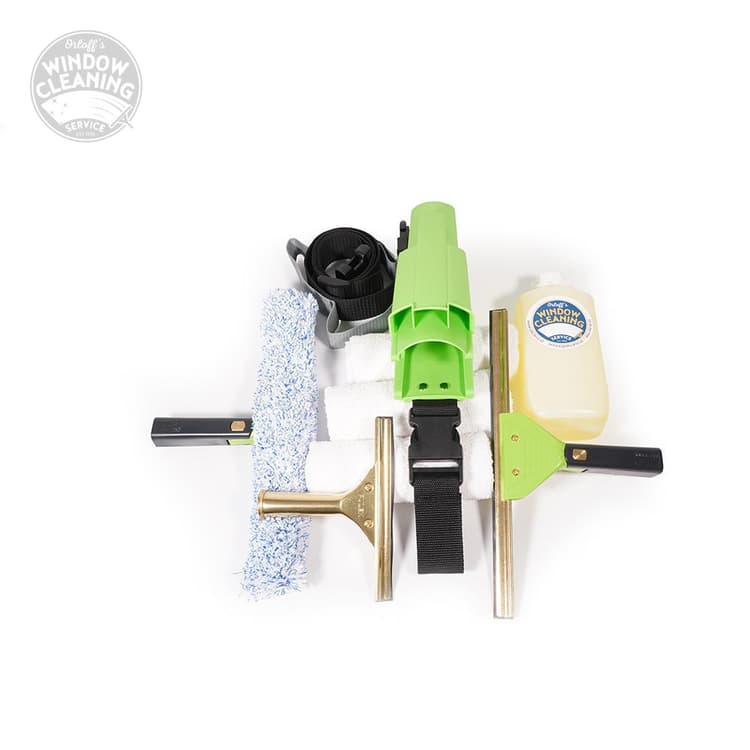
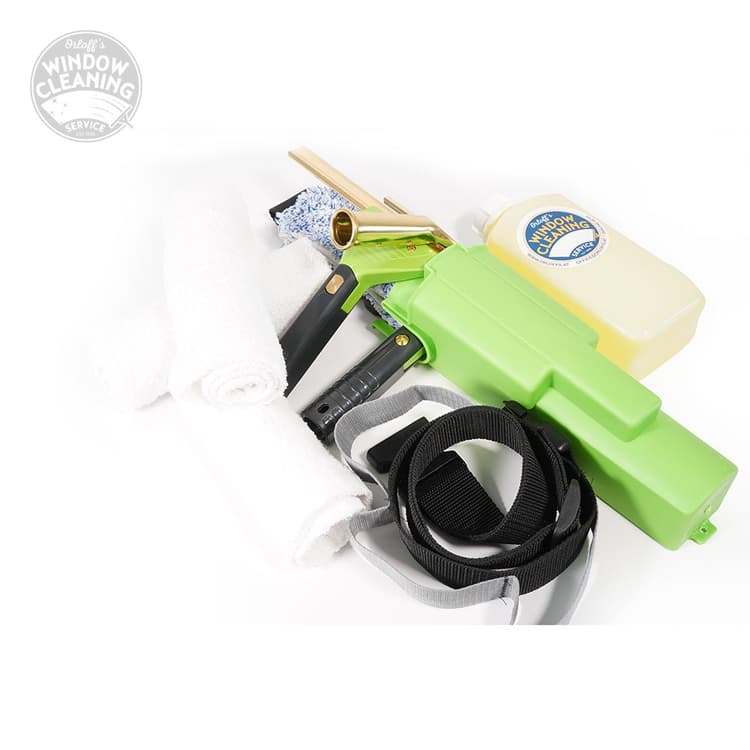
My daily tool list. This is what I carry to every job.
Follow these steps in order. Each one builds on the last. This is the same sequence I use on every Aluplast installation.
- 1
Assess the frame and glass condition
Before touching any product, look at the overall frame - note yellowing, scratches, foil lifting, or hardware staining.
Check drainage slots at the base of the outer frame for blockage. Blocked drainage is the single most common cause of frame staining.
On foil-laminated frames, check the edges of the foil at corners and hardware cutouts for lifting.
- 2
Flush drainage slots
Use a soft brush to clear any visible debris from drainage holes at the bottom of the frame.
Pour a small amount of clean water into the outer rebate channel and watch that it exits through the drainage holes freely.
If water pools, probe gently with a plastic tool - never metal, which scores the PVC.
- 3
Clean glass first
Apply pH-neutral glass cleaner to a damp microfibre cloth and wipe the glass in overlapping horizontal passes.
Follow immediately with a dry rubber squeegee, working top to bottom.
Dry the frame rebate where glass meets frame with a clean cloth to remove any solution that ran down.
- 4
Clean PVC frames
Mix warm water with a small amount of pH-neutral washing-up liquid in a bucket.
Wipe all frame faces, sill, and head with a soft microfibre cloth. Work from top to bottom, rinsing the cloth regularly.
For foil-laminated surfaces, use the same solution but wring the cloth out more - avoid pooling water at foil edges.
- 5
Lubricate all hardware
Open the sash fully and apply a small amount of light machine oil to each visible hinge knuckle.
Run a single drop of oil down the espagnolette bar where it contacts each locking keep.
Operate the handle through tilt and turn positions three times to work the lubricant into all contact points, then wipe excess from the frame face.
- 6
Final check and documentation
Close and lock each sash - resistance should be smooth. If a sash is stiff, note the window for hinge adjustment.
Check the outer perimeter seal (the compression seal between sash and frame) for brittleness or gaps.
Record the service date. aluplast-profiled windows in normal residential use should be serviced once yearly.
Pro Tips
- White PVC yellows fastest on south-facing elevations. Annual PVC restorer cream on these windows adds years to the visible finish.
- Foil-laminated frames in dark colours (anthracite, black) absorb more heat and expand more. Check foil edge adhesion on these windows first each spring.
- Never use a pressure washer on PVC windows. The jet forces water behind glazing beads and into hardware keeps.
- If white PVC frames have brown rust staining near hardware, the steel espagnolette bar inside the frame has corroded. Lubrication alone will not fix this - the bar needs replacing.
- On tilt-and-turn windows, always check the tilt function as well as the turn. Hardware faults often show in tilt mode first.
- Drainage holes are usually hidden under the outer sill overhang. Use a mirror or phone camera to check them rather than guessing.
- aluplast profiles are widely available to fabricators - if a frame section is damaged, replacement profiles through the original fabricator are usually possible.
What NOT To Do
- Do not use abrasive pads, scouring powder, or steel wool on any PVC surface.
- Do not apply solvent-based cleaners (acetone, white spirit, paint thinner) to PVC or foil-laminated frames.
- Do not pressure-wash windows at any pressure setting.
- Do not oil hardware by spraying directly onto PVC frame faces.
- Do not ignore a dropped or dragging sash - frame damage follows quickly if the fault is left unaddressed.
Bundle Kits and Tool Recommendations
Bundle Kit
Tool Recommendations
pH-neutral window cleaning solution
View on Amazon [coming soon]Microfibre window cloths (pack)
View on Amazon [coming soon]Rubber window squeegee
View on Amazon [coming soon]Cleaning Frequency
Glass cleaning: Every 6-8 weeks (More often on ground floor or near roads.). Frame cleaning: Every 3-4 months (South-facing frames may need more frequent attention in summer.). Hardware lubrication: Twice yearly (Spring and autumn are ideal timing.). Full service check: Annually (Drainage, seals, hardware adjustment, and frame condition review.)
Frequently Asked Questions
Field Notes
“aluplast profiles are made in Germany to consistent tolerances, but the finished window quality depends entirely on the fabricator. The same profile in two different windows can feel completely different. Yellowing on white aluplast-profiled windows is a surface phenomenon in most cases. A quality PVC restorer cream recovers around 80% of the original white in our experience. The IDEAL 7000 system is the most common profile we encounter in Austrian residential work. Hardware access points are well-positioned and maintenance is straightforward.”
Justin Orloff
What's next for you?
The Skill
New to window cleaning?
Start with the core techniques before tackling premium systems.
Start Learning →The Standard
Upskill your team
Covers every system, product type, and tricky scenario.
View The Standard →Manufacturer
Partner with Orloffs
Are you Aluplast or a similar manufacturer? Let's create official cleaning guidance together.
Get in Touch →